
☕🤖 Tutorial: Turn Your Website Analytics Into a Monthly Growth Playbook (With AI)
PLUS: everything you need + all prompts inside...


Hey AI Breakers 👋
You log into Google Analytics, see a bunch of numbers, and think: okay… now what?
Most people use analytics like a report card → check it, react, close the tab. But the real value is turning “what happened” into “what do we do next,” and that’s where things stall:
Traffic drops with no clear cause or fix
Bounce rates show problems, but not priorities
“Insights” don’t translate into an action plan
Too much time spent analyzing, not improving
Dashboards don’t drive growth decisions
Today, you’ll build an AI Analytics Strategist that turns GA exports into a prioritized monthly action plan.
Let’s build it 👇

🧠 How the AI Analytics Strategist Works
Traditional analytics review: Export data → Stare at spreadsheets → Make educated guesses → Maybe implement something → Repeat next month. Time investment: 4-6 hours.
Actual clarity: Low.
The AI Analytics Strategist flips this. You feed it your Google Analytics data (traffic sources, page performance, user behavior, conversion events). It identifies patterns humans miss, diagnoses root causes, and outputs a ranked action plan with specific fixes. Time investment: 45 minutes. Actual clarity: High.
No more guessing what to work on next.
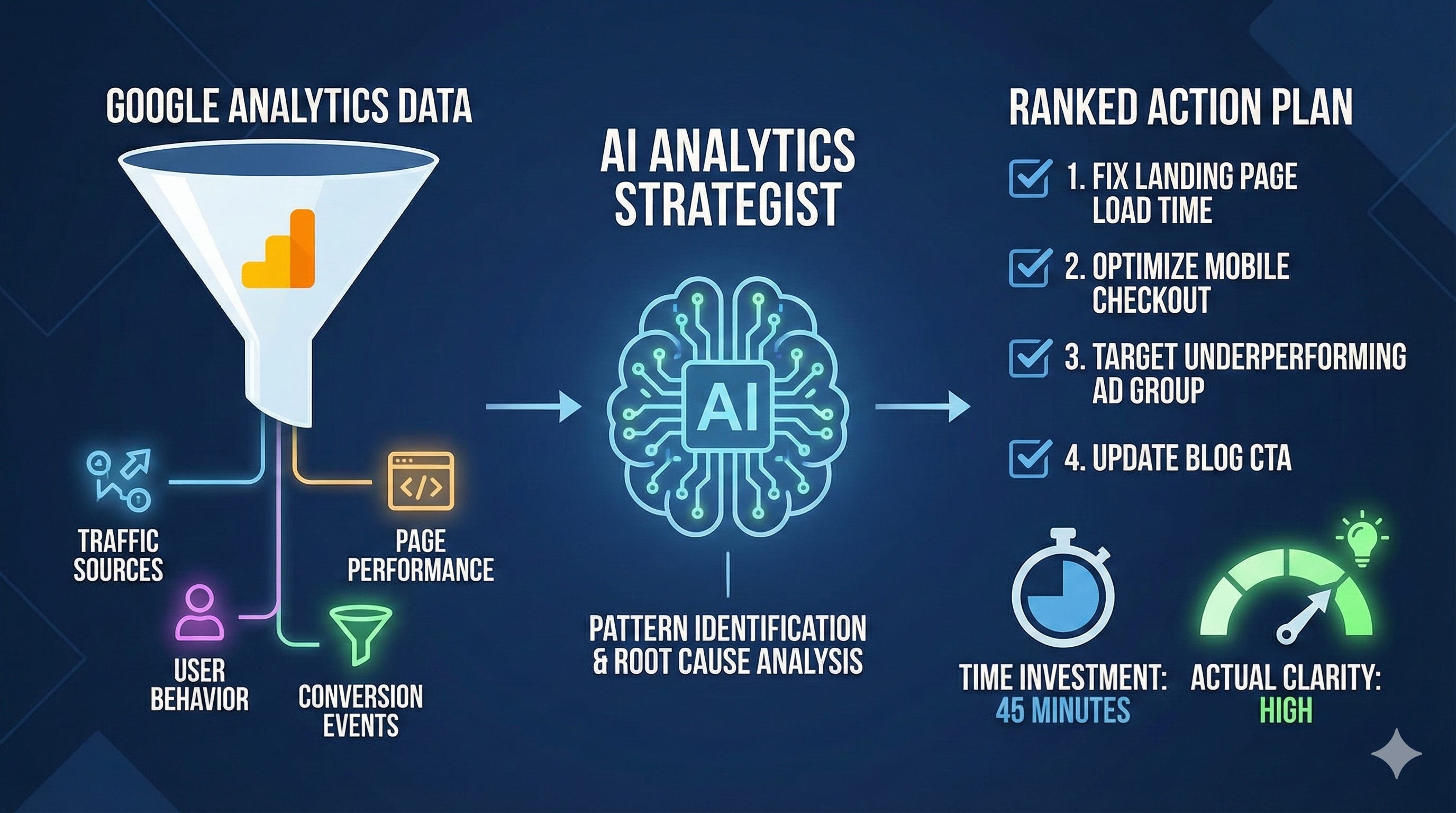
🔎 Prompt #1 → The Traffic Pattern Decoder (finds what’s working and what’s dying)
Start by feeding your analytics data to AI and asking it to identify patterns.
Goal: Get a clear picture of which pages are winning, which are losing, and where users are getting stuck.
Identify top performers (high traffic + engagement)
Flag underperformers (traffic drop or high bounce)
Spot unusual patterns (sudden spikes, seasonal trends)
Map user journey bottlenecks
Prompt:
You are a senior web analytics strategist specializing in traffic pattern analysis and user behavior insights.

I'm going to share Google Analytics data from my website. Your job is to analyze this data and identify key patterns, opportunities, and problems.

Here's my analytics data:

[PASTE YOUR ANALYTICS DATA — include: page URLs, pageviews, unique visitors, avg. time on page, bounce rate, traffic sources, and date range]

Your tasks:

1. **Top Performers Analysis**: Identify the top 5 pages by traffic and engagement. For each, explain WHY it's performing well (traffic source, topic relevance, user intent match, etc.).

2. **Underperformers Diagnosis**: Identify the 5 worst-performing pages (high bounce rate, low time on page, or declining traffic). For each, hypothesize WHY it's failing.

3. **Traffic Source Breakdown**: Analyze which channels (organic, direct, referral, social, paid) are driving the most valuable traffic. Define "valuable" by engagement metrics, not just volume.

4. **User Journey Mapping**: Based on the data, map out the most common user paths. Where do people enter? Where do they drop off? What pages act as "bridges" to conversions?

5. **Anomaly Detection**: Flag any unusual patterns — sudden traffic spikes, seasonal trends, pages that should perform well but don't, or unexpected referral sources.

6. **Quick Wins List**: Identify 3 immediate opportunities where small changes could yield big results (e.g., a high-traffic page with a fixable bounce rate issue).

Format your response as a structured report with clear headings for each section. Be specific — reference actual page URLs and metrics. Avoid generic advice.
💡 Tip: Export a 30-day or 90-day range from Google Analytics. Include at least: page URLs, sessions, users, bounce rate, avg. session duration, and traffic source. The more context you give, the better the analysis.
🧠 Prompt #2 → The Root Cause Investigator (diagnoses WHY pages fail)
Now that you know which pages are underperforming, figure out why.
Goal: Get specific diagnoses for each problem page so you know exactly what to fix.
Identify content gaps or quality issues
Spot technical problems (slow load, mobile issues)
Diagnose user intent mismatches
Flag structural or UX problems
Prompt:
You are a conversion rate optimization specialist and UX analyst with expertise in diagnosing website performance issues.

I've identified underperforming pages on my website. Now I need you to diagnose the root causes of why these pages are failing.

Here are the underperforming pages from my previous analysis:

[PASTE OUTPUT FROM PROMPT #1 — specifically the "Underperformers Diagnosis" section]

For context, here's additional information about my website:
- Industry: [YOUR INDUSTRY]
- Target audience: [YOUR TARGET AUDIENCE]
- Primary conversion goals: [e.g., newsletter signup, product purchase, contact form submission]
- Average site speed: [if known, otherwise say "unknown"]

Your tasks:

1. **Content Quality Assessment**: For each underperforming page, evaluate likely content issues — is it too thin, outdated, off-topic, poorly structured, or missing key information users expect?

2. **User Intent Mismatch Analysis**: Determine if the page content matches what users are searching for or expecting when they land there. If there's a mismatch, explain what they wanted vs. what they got.

3. **Technical Problem Hypothesis**: Identify potential technical issues — slow load times, mobile responsiveness problems, broken elements, poor readability, or confusing navigation.

4. **Conversion Barrier Identification**: For each page, list specific barriers preventing users from taking the next step (unclear CTA, no CTA, trust issues, information overload, etc.).

5. **Competitive Context**: Based on the page topic and industry, explain what high-performing competitor pages likely do better.

6. **Fix Priority Ranking**: Rank each underperforming page by fix difficulty (easy/medium/hard) and potential impact (low/medium/high). Prioritize "easy + high impact" fixes.

Format your response as a detailed diagnostic report. For each page, provide a clear "Root Cause Summary" and "Recommended Fix Direction" before moving to the next page.
🧠 Tip: If you have access to heatmaps (Hotjar, Crazy Egg) or user session recordings, mention key observations in the prompt.
🎯 Prompt #3 → The Opportunity Scorer (ranks fixes by impact)
You now have a list of problems and diagnoses. But you can’t fix everything at once.
Goal: Know exactly what to work on first, second, third based on ROI.