
☕🤖Tutorial: Create a Pricing Strategy in 45 Minutes (With AI)
PLUS: everything you need + all prompts inside...


Hey AI Breakers 👋
Let’s talk pricing.
Most founders set a number once (usually based on gut feel or a competitor) and never touch it again. That’s how you end up undercharging, overpricing, or leaving a big chunk of revenue on the table.
Today you’ll build a Pricing Strategist: five chained prompts that benchmark competitors, estimate willingness to pay, design tiers, and give you a clear testing plan.
Let’s build it 👇

🧠 How the Pricing Strategist Works
Most founders treat pricing as a one-time decision. Set it and forget it. But pricing is the single highest-leverage variable in your business. A 10% price increase on the same volume drops straight to the bottom line.
No extra traffic. No extra work. Just more money for the same effort.
The Pricing Strategist works in five stages: Benchmark → Analyze → Structure → Message → Test.
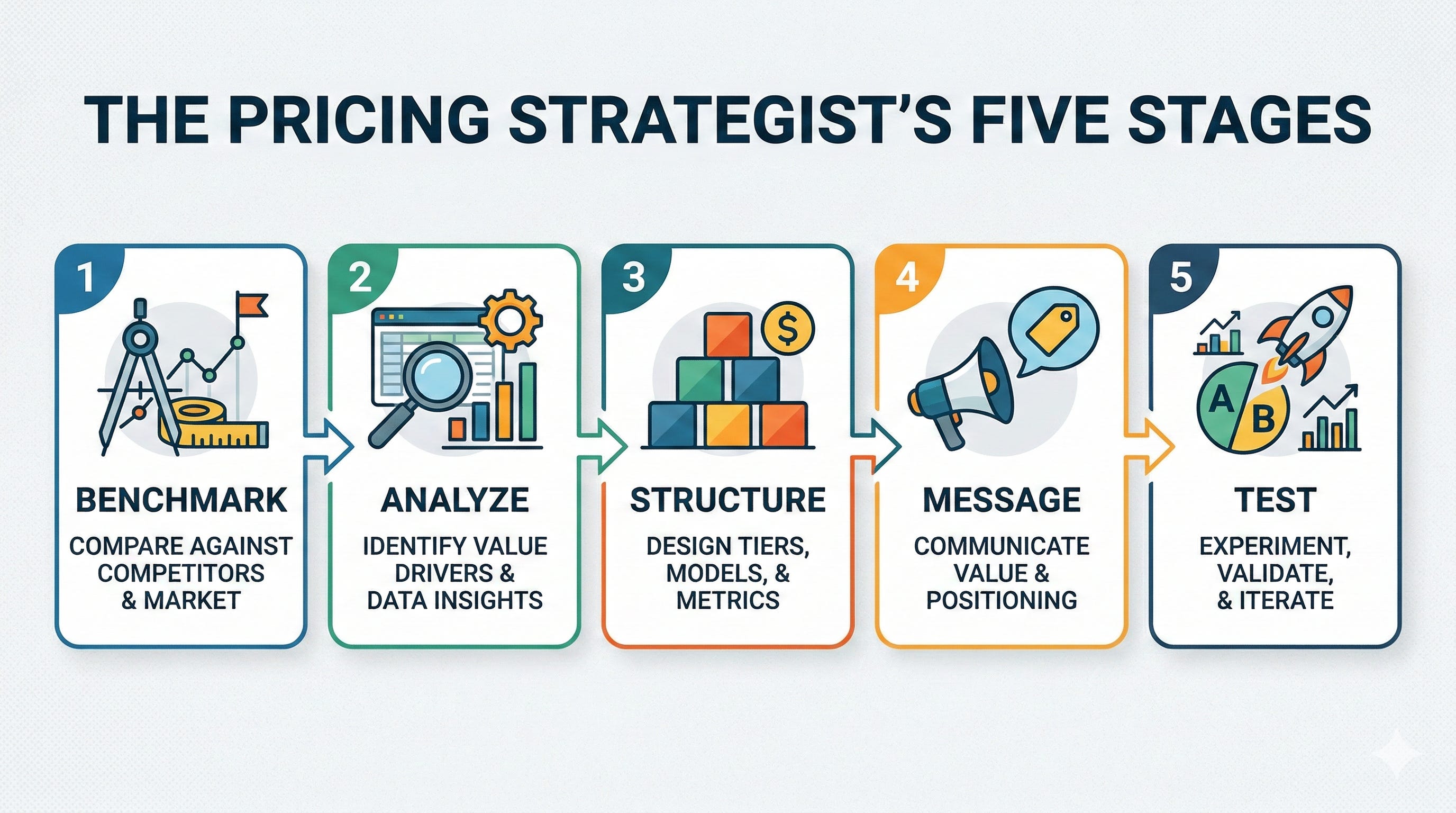
First, you map your competitive landscape to understand where you sit.
Then you model willingness-to-pay based on your specific audience. From there, you build a tiered pricing architecture designed to capture more value.
You craft the messaging that makes each tier feel like an obvious choice. And finally, you build a test plan so you validate with real data instead of guessing.
What used to require a pricing consultant charging $5K-$15K now takes about 45 minutes and a focused session with ChatGPT or Claude.
🔎 Prompt #1 → The Market Scanner (Map Your Competitive Landscape)
You can’t price in a vacuum. Before you touch your own numbers, you need to know the terrain. What are competitors charging? How do they structure their plans? Where are the gaps? This prompt gives you the lay of the land in minutes.
Map competitor pricing across your market
Identify pricing patterns and positioning gaps
Spot where competitors are overcharging or underdelivering
✅ Use this anytime you’re launching, repricing, or entering a new market.
Pro tip: Use the following prompt in “Deep research” mode for better results.
Prompt:
You are a competitive intelligence analyst specializing in pricing strategy.

I run a [TYPE OF BUSINESS, e.g., SaaS tool, online course, coaching practice, e-commerce brand].

My product/service: [1-2 sentence description of what you sell and who it's for]
My current price: [e.g., $29/month, $497 one-time, $2,000/engagement]
My top 5 competitors (or closest alternatives): [list them, or say "I don't know, research my space"]

Your task:
1. For each competitor, create a pricing breakdown:
   - Price points and plan names
   - What's included at each tier
   - Free trial or freemium offering (yes/no, details)
   - Annual discount structure (if any)
   - Notable upsells or add-ons

2. Identify the pricing "center of gravity" in this market (what most players charge)

3. Map the pricing spectrum from budget to premium, and place me on it

4. Identify 3 pricing gaps or opportunities:
   - Where no one is competing on price
   - Features that are overpriced relative to value
   - Underserved segments willing to pay more

5. Rate my current price as: significantly underpriced / slightly underpriced / market rate / slightly overpriced / significantly overpriced. Explain why.

Present as a structured competitive pricing report with a summary table.
💡 Tip: If you don’t know your competitors, just describe your product and target audience. Ask the AI to identify your top 5 competitors first, then run the analysis. Two prompts instead of one, but you get a cleaner result.
📊 Prompt #2 → The Value Mapper (Understand What Customers Will Actually Pay)
Competitor pricing tells you what the market looks like. But willingness-to-pay tells you what your specific audience values enough to open their wallet.