
☕🤖Tutorial: Replace your $5K/month SEO Agency with AI
PLUS: everything you need + all prompts inside...


Hey AI Breakers 👋
You’re paying an agency thousands a month for keyword reports you barely understand and posts/pages that don’t rank.
Today, you’ll build an AI SEO Engine that handles keyword research, competitor analysis, content briefs, on-page optimization, and a full publishing calendar.
✅ A complete SEO audit of your current positioning and gaps
✅ High-value keyword clusters organized by search intent
✅ A competitor breakdown showing exactly what’s ranking and why
✅ Ready-to-write content briefs for your top keyword opportunities
✅ Optimized meta titles, descriptions, and header structures
✅ A 90-day SEO content calendar with priorities and deadlines
Let’s build it 👇

🧠 How the AI SEO Engine Works
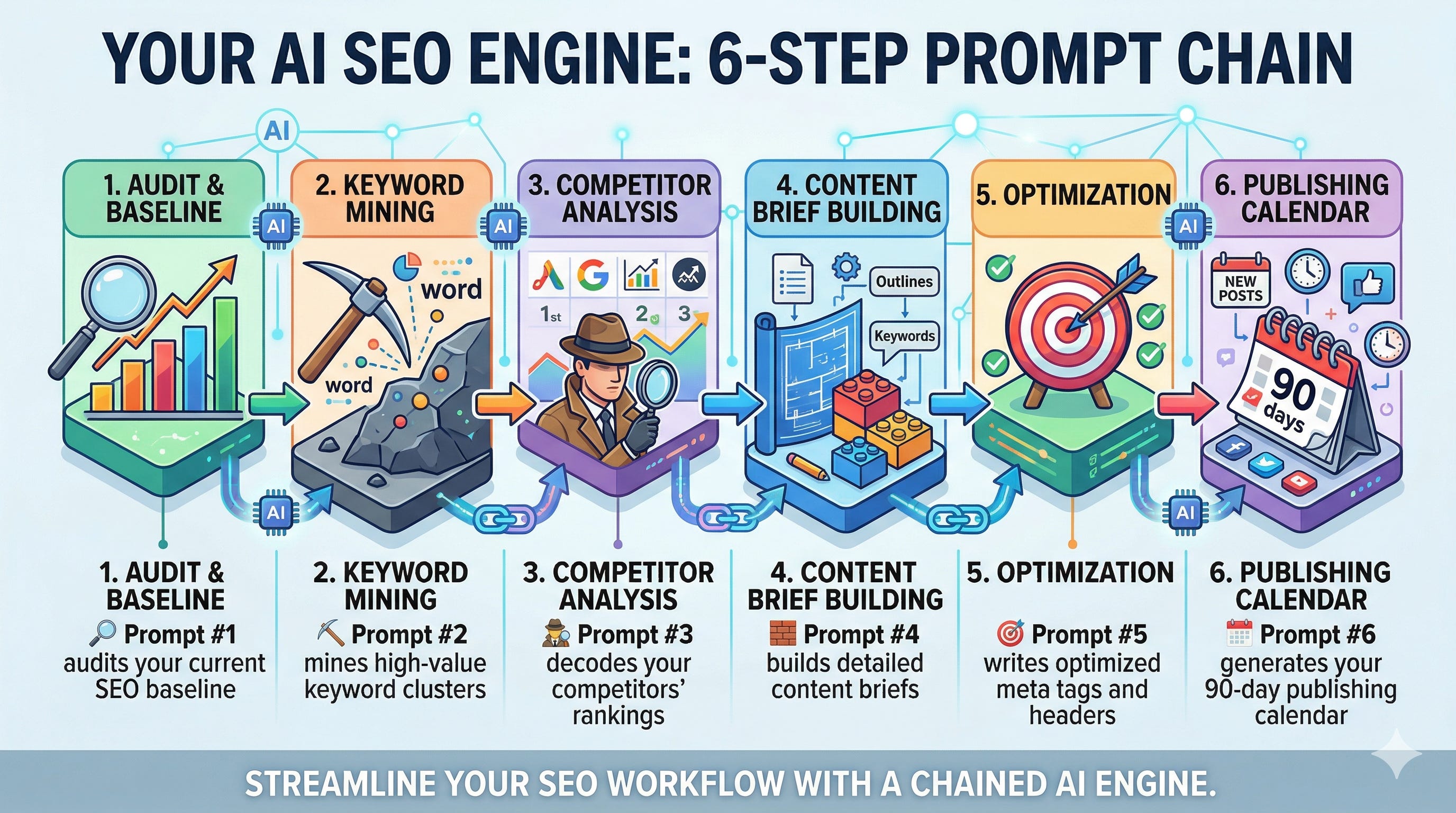
Most SEO agencies follow the same playbook. Audit your site, research keywords, check competitors, write content briefs, optimize pages, and schedule publishing.
The problem isn’t the process. It’s the $5K/month price tag and the 3-week turnaround for a keyword report.
Your AI SEO Engine runs that entire process in 6 chained prompts:
🔎 Prompt #1 audits your current SEO baseline
⛏️ Prompt #2 mines high-value keyword clusters
🕵️ Prompt #3 decodes your competitors’ rankings
🧱 Prompt #4 builds detailed content briefs
🎯 Prompt #5 writes optimized meta tags and headers
📅 Prompt #6 generates your 90-day publishing calendar
What used to take an agency 2-3 weeks (and cost you thousands) now takes 45 minutes with ChatGPT or Claude.
🔎 Prompt #1 → The SEO Auditor (Know Where You Stand)
Before you optimize anything, you need to know your starting point. This prompt maps your current SEO landscape so every decision after this is data-informed.
✅ Use this to get a clear picture of your SEO strengths, weaknesses, and quick wins.
Prompt:
You are an expert SEO strategist with 15 years of experience auditing websites for organic growth.

I need a comprehensive SEO audit for my business. Here are my details:

- Business name: [YOUR BUSINESS NAME]
- Website URL: [YOUR WEBSITE URL]
- Industry/niche: [YOUR INDUSTRY]
- Main products or services: [LIST YOUR TOP 3-5 PRODUCTS/SERVICES]
- Target audience: [WHO YOU'RE TRYING TO REACH]
- Current monthly website traffic (estimate): [YOUR TRAFFIC ESTIMATE]
- Top 3 pages that get the most traffic: [LIST THEM IF YOU KNOW]
- Are you currently publishing blog content? [YES/NO, HOW OFTEN]

Perform the following analysis:

1. POSITIONING ASSESSMENT
   - Based on my business and industry, identify what my site SHOULD be ranking for
   - List 5 "money keywords" (high commercial intent) I should own
   - List 5 "authority keywords" (informational) that would build topical authority

2. GAP ANALYSIS
   - Identify 5 likely content gaps where my competitors probably rank but I probably don't
   - Flag any obvious structural SEO issues based on what you know about my site type
   - Note whether my content frequency is adequate for my niche

3. QUICK WINS
   - List 5 immediate actions I can take this week to improve my SEO
   - Prioritize by impact (high/medium/low) and effort (easy/moderate/hard)

4. BASELINE SCORECARD
   - Rate my likely SEO maturity on a scale of 1-10 across: Content Quality, Content Volume, Topical Authority, Technical Foundation, Backlink Profile
   - Explain each rating in one sentence

Format the output with clear headers, bullet points, and a summary table for the scorecard.
💡 Tip: If you have access to Google Search Console or any analytics tool, paste your top 20 performing keywords into the prompt. The more real data you feed it, the more accurate the audit gets.
⛏️ Prompt #2 → The Keyword Miner (Find the Gold in Your Niche)
This is where the real value starts. Instead of a spreadsheet with 500 random keywords, you’ll get organized clusters grouped by what the searcher actually wants.
✅ Use this to build a keyword map that drives your entire content strategy.
Prompt:
You are a senior SEO keyword researcher who specializes in finding high-ROI keyword opportunities for small and mid-size businesses.

Here is my SEO audit:
[PASTE YOUR FULL OUTPUT FROM PROMPT #1]

Based on this audit, perform deep keyword research:

1. KEYWORD CLUSTER MAP
   Generate 8 keyword clusters for my business. For each cluster:
   - Cluster name (the topic theme)
   - Primary keyword (highest volume, main target)
   - 5-7 supporting keywords (long-tail variations, questions, related terms)
   - Search intent label: Informational, Commercial, Transactional, or Navigational
   - Estimated difficulty: Low, Medium, or High
   - Business value: How directly this connects to revenue (1-5 scale)

2. LOW-HANGING FRUIT
   Identify 10 long-tail keywords where I could realistically rank on page 1 within 60 days. These should be:
   - Low competition
   - Clear search intent
   - Directly relevant to my products/services
   - At least some monthly search volume

3. QUESTION KEYWORDS
   List 15 questions my target audience is searching for related to my business. Group them by:
   - "What" questions (awareness stage)
   - "How to" questions (consideration stage)
   - "Best" / "vs" questions (decision stage)

4. CONTENT TYPE RECOMMENDATIONS
   For each of the 8 clusters, recommend the best content format:
   - Blog post, pillar page, landing page, comparison page, how-to guide, listicle, or FAQ page

Format everything in organized tables where possible.
🧠 Tip: Cross-reference these clusters with free tools like Google’s “People Also Ask” boxes and autocomplete suggestions. Search your primary keywords and see if the AI’s clusters match what Google actually shows. That’s your validation.
🕵️ Prompt #3 → The Competitor Decoder (Reverse-Engineer What’s Ranking)
Your competitors have already spent months (and thousands) figuring out what works. This prompt reverse-engineers their strategy so you can skip the trial and error.
✅ Use this to understand exactly why your competitors rank and where they’re vulnerable.