
☕🤖Tutorial: How To Turn Claude Code Into Your Personal Content Writer
PLUS: everything you need + all prompts inside...


Hey AI Breakers 👋
AI content sounds generic because it doesn’t know you. Claude Code fixes that. You load it with your voice, your business context, and your best posts, and it remembers everything across sessions.
Today, you’ll build an AI Brand Writer workspace inside Claude Code that writes content in your exact voice, every time.
A voice profile extracted from your real writing
A business-info.md with your company context
A content-structure.md with voice rules and platform formats
A reference/ folder with your best posts as examples
A CLAUDE.md that ties it all together and routes Claude to the right files
A slash command (skill) that generates on-brand content with one line
Let’s build it 👇
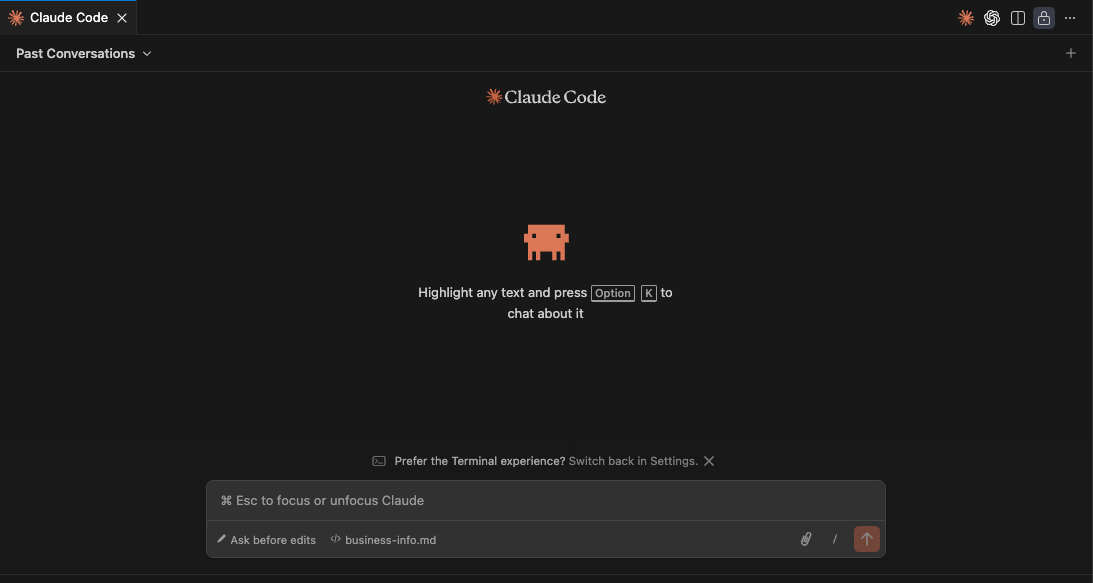
PS: We run Claude Code on Visual Studio
How the AI Brand Writer Works
Claude Code reads your CLAUDE.md file automatically at the start of every session. But instead of cramming everything into one file, we’ll build a smart workspace:
📄 business-info.md : who you are, what you do, your audience
✍️ content-structure.md : your voice rules + platform-specific formats (LinkedIn hooks, X structure, etc.)
📂 reference/ : your 5-10 best posts organized by platform
🧠 CLAUDE.md : the routing file that tells Claude “read these files before writing anything”
When you ask Claude Code to write a LinkedIn post, it automatically reads your business context, checks your voice rules, looks at your reference posts, and writes in your style. No copy-pasting between tools.
🔎 Prompt #1 → The Voice Extractor (Capturing How You Actually Write)
First, extract your writing voice. Run this in ChatGPT or Claude (not Claude Code yet).
The goal:
Identify your unique patterns, sentence structures, and word choices
Capture your tone, personality, and quirks
Get a voice profile you’ll use in the next steps
✅ Use this to turn vague “write in my voice” into specific, repeatable rules.
Prompt:
You are a brand voice analyst who studies writing patterns to create detailed voice profiles for content teams.

I'm going to give you 3-5 pieces of my best content. Analyze them and extract my unique writing voice.

Here are my content samples:

[PASTE 3-5 OF YOUR BEST POSTS, ARTICLES, OR NEWSLETTERS HERE — the ones that sound most "like you" and performed well]

Your tasks:

1. Analyze my writing patterns across all samples. Identify:
   - Average sentence length (short and punchy? Long and flowing? Mixed?)
   - Paragraph structure (how many sentences per paragraph?)
   - Opening style (how do I start pieces? Questions? Statements? Stories?)
   - Transition style (how do I move between ideas?)
   - Closing style (how do I end pieces?)

2. Identify my tone markers:
   - Formality level (1-10 scale, with examples)
   - Humor style (if any)
   - Energy level (calm? High energy? Conversational?)
   - Confidence style (authoritative? Humble? Direct?)

3. Extract my vocabulary patterns:
   - Words and phrases I use repeatedly
   - Words and phrases I NEVER use
   - Industry jargon I use vs. avoid
   - Emoji usage (yes/no, which ones, how often?)

4. Identify my structural habits:
   - Do I use bullet points or prose?
   - Do I use bold/italics? How?
   - Do I use questions to the reader?
   - Do I use "you" or "we" or "I"?
   - Any signature phrases or patterns?

5. Write a "Voice Profile" (150-200 words) formatted as clear rules, not descriptions. Example: "Use short sentences. Max 2 sentences per paragraph. Never say 'utilize' — say 'use'."
💡 Tip: Pick content that got the best engagement AND sounds most like you. Skip anything ghostwritten or heavily edited by someone else.
📄 Prompt #2 → The Business Info File (Your Company Context)
Now open Claude Code. From this point on, everything happens inside Claude Code. Paste this prompt directly into Claude Code and it will create the file for you.
The goal:
Create a business-info.md file Claude reads for company context
Cover who you are, what you do, and who your audience is
Keep it factual and scannable
✅ Use this so Claude always knows your business context without you repeating it.
Prompt:
Create a file called business-info.md in the root of this project.

Here's my business information:

Business name: [YOUR BUSINESS NAME]
What we do: [ONE SENTENCE — what your business does]
Industry: [YOUR INDUSTRY]
Target audience: [WHO YOUR CUSTOMERS/READERS ARE — be specific about their role, industry, pain points]
Products/services: [WHAT YOU SELL OR OFFER]
Key differentiator: [WHAT MAKES YOU DIFFERENT FROM COMPETITORS]
Website: [YOUR WEBSITE]
Social platforms: [WHERE YOU POST — LinkedIn, X, newsletter, etc.]
Content topics: [3-5 TOPICS YOU REGULARLY WRITE ABOUT]
Brand mission: [ONE SENTENCE — why your brand exists]
Recent milestones: [2-3 RECENT ACHIEVEMENTS worth mentioning in content]

Format the file as a clean markdown document with these sections:
- ## Company Overview (name, what we do, industry, differentiator)
- ## Target Audience (who they are, what they care about, their pain points)
- ## Products & Services (what we offer)
- ## Content Focus (platforms, topics, posting frequency)
- ## Key Facts (milestones, stats, anything Claude should know)

Keep it under 300 words. Bullet points, not paragraphs.
🧠 Tip: Be specific about your audience. “Founders and business owners aged 30-50 who use AI but aren’t technical” is way better than “professionals.”
✍️ Prompt #3 → The Content Structure File (Voice + Platform Formats)
This is where the magic lives. Your voice rules AND the structure for each platform, all in one file.